
 Türkçe
  English
  فارسی
فارسی  Russian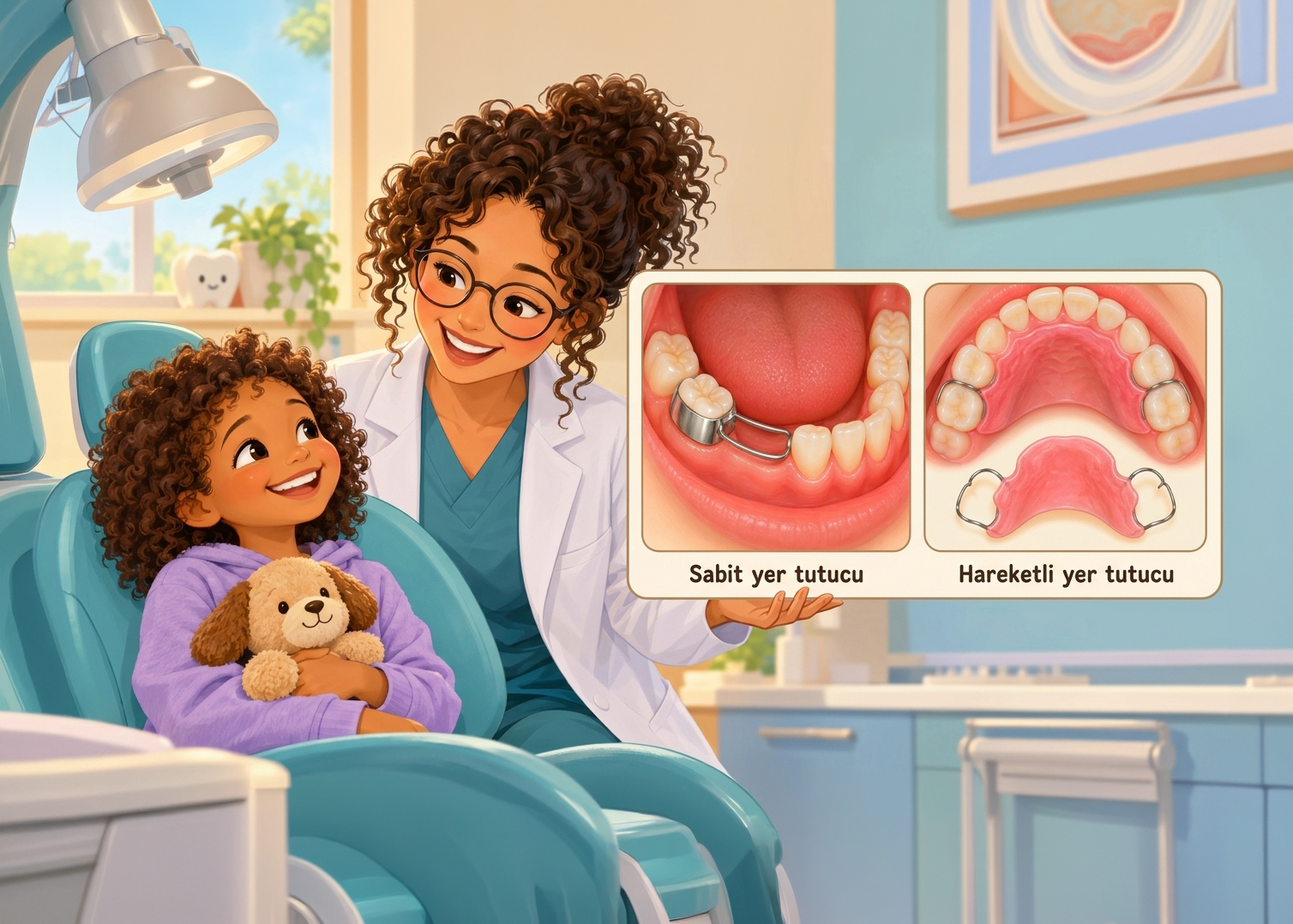
If a Primary Tooth Is Lost Early: What Is a Space Maintainer?
You may wonder, “Primary teeth were going to fall out anyway, so what difference does it make if one is extracted?” However, primary teeth not only help children chew and speak, but also maintain space in the mouth for the permanent teeth that will erupt underneath them.
When a primary tooth is lost prematurely due to decay or trauma, the neighboring teeth may move toward the empty space. As a result, the area where the permanent tooth will erupt may become narrower. A space maintainer is an appliance used, when necessary, to preserve this space.
Is a space maintainer necessary after every primary tooth extraction?
No. The decision depends on which tooth was lost, the child’s age, the development of the permanent tooth, and the amount of space currently available in the mouth. A pediatric dentist examines the child and, when necessary, evaluates the condition of the underlying permanent tooth using an X-ray to determine whether a space maintainer is needed. If a primary tooth has been lost prematurely, it is advisable not to wait too long for an evaluation. Deciding early whether the space needs to be preserved can help prevent space loss that may occur as the permanent teeth erupt.
What are the types of space maintainers?
Space maintainers can be fixed or removable. Fixed space maintainers are attached to the teeth and cannot be removed by the child. Removable space maintainers can be inserted and removed as recommended by the dentist. The appropriate type depends on the location of the missing tooth and the child’s individual needs.
Is a space maintainer the same as an orthodontic appliance?
A space maintainer is also an appliance placed in the mouth; however, its primary purpose is to preserve the existing space left by a prematurely lost primary tooth. Orthodontic appliances may have different purposes, such as guiding the position of the teeth or the development of the jaws.
Sometimes, after a primary tooth is lost, neighboring teeth may have moved toward the empty space, reducing the area available for the permanent tooth. In such cases, simply placing a space maintainer may not be sufficient; the lost space may first need to be regained. The appropriate treatment is determined after a clinical examination.
What should be considered after a space maintainer is placed?
The teeth and gums around the space maintainer should be cleaned carefully. Particular attention should be paid to sticky and hard foods that may put stress on fixed space maintainers. If the appliance becomes loose or breaks, if it irritates the gums, or if it causes pain, a pediatric dentist should be consulted.
Regular check-ups are also important. As the child grows and the permanent tooth approaches eruption, the condition of the space maintainer is reassessed and, when appropriate, it is removed by the dentist.
In short, a space maintainer helps preserve the space left by a prematurely lost primary tooth. If your child has lost a primary tooth early, do not simply assume that “another tooth will come anyway.” Ask your pediatric dentist whether a space maintainer is needed.